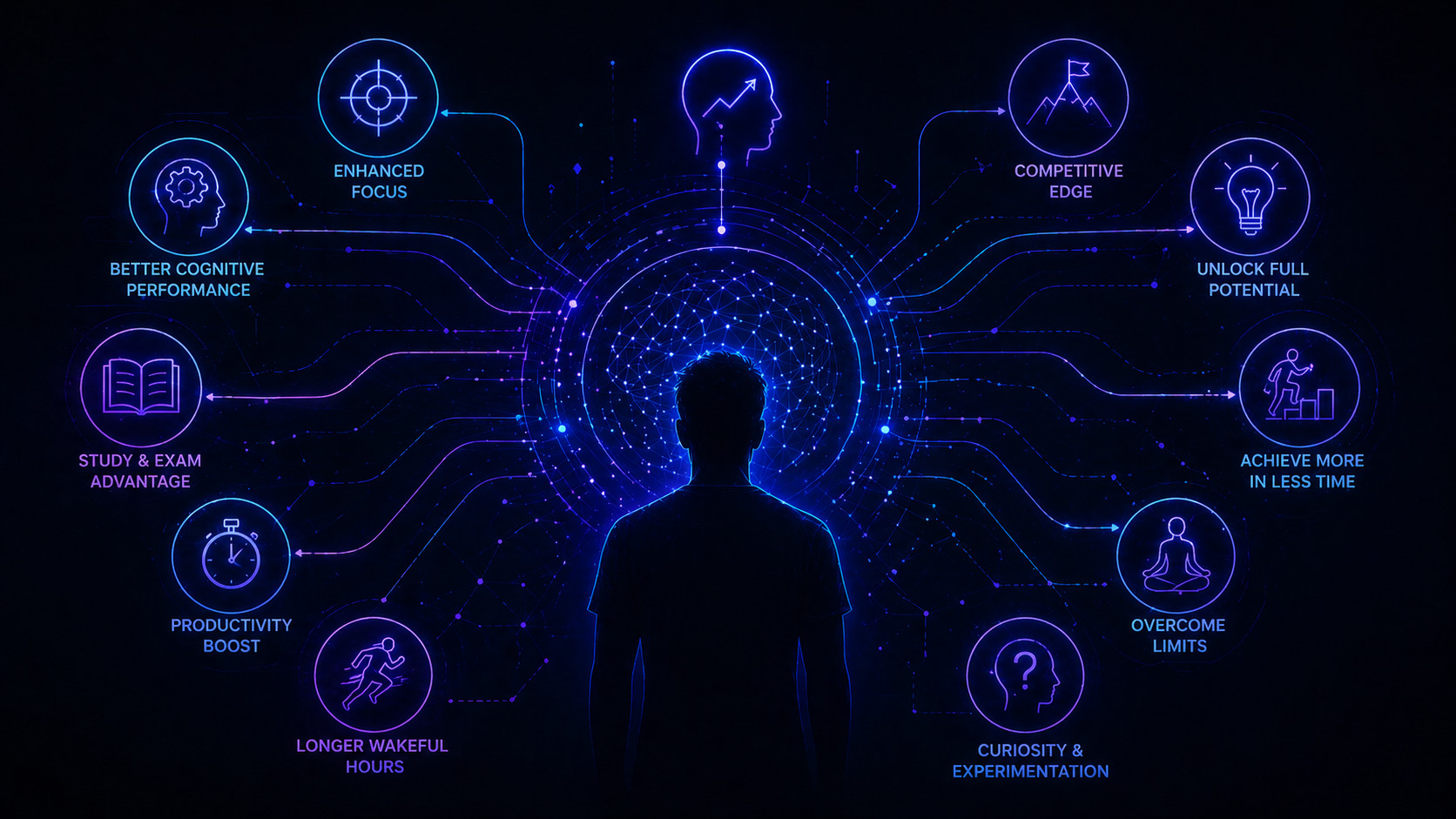
There’s a moment in Limitless that tends to stick. Not the obvious ones-the high-stakes deals, the fast-talking brilliance, the surreal confidence-but that quieter shift when Eddie Morra realizes the fog is gone. Not reduced. Gone. Language sharpens. Memory stops slipping. Patterns appear where there was once only noise. It feels less like gaining something new and more like recovering something lost.
And that’s usually where the search for NZT-48 begins.
The First Thought: What if this isn’t entirely fiction?
People don’t go looking for NZT-48 because they think a glowing, translucent tablet exists in some hidden lab waiting to be shipped.
Not really.
They search because the idea refuses to stay contained inside the movie.
It leaks.
Into late nights when focus dissolves. Into conversations where the right word almost arrives but doesn’t. Into that strange awareness that the brain-this thing we rely on constantly-operates far below its theoretical ceiling.
The film gives that feeling a shape. A name. A mythology.
NZT-48 becomes shorthand for a question people were already asking:
How much better could this get?
NZT-48 as a Mirror, Not Just a Fantasy
The mythology works because it’s not entirely alien.
Eddie doesn’t become someone else. He becomes more of himself. Faster. Clearer. Less blocked.
That distinction matters.
The fascination isn’t about becoming superhuman in a comic-book sense. It’s about removing friction. Eliminating hesitation. Unlocking what’s already there but buried under distraction, fatigue, or doubt.
In real life, there’s no equivalent switch. No clean activation.
But there are glimpses.
Moments of deep focus where time bends. Periods where memory feels unusually accessible. Days where thinking flows instead of stalls.
Psychology has a word for some of this-“flow state.” It’s been studied for decades, described as a condition where attention is fully absorbed and performance feels almost effortless. The concept isn’t fictional at all; it’s grounded in research like this overview from the National Center for Biotechnology Information.
But flow is fragile. Temporary. Unreliable.
NZT-48, in contrast, is stable. Instant. Controlled.
That’s the real fantasy.
Why People Search for NZT-48 (Even Knowing It’s Fiction)
1. The Frustration of Untapped Potential
There’s a quiet irritation that many people carry: the sense that they’re operating below capacity.
Not dramatically. Just enough to notice.
Forgetting small things. Losing focus mid-task. Feeling mentally slow at the wrong time.
NZT-48 offers a clean resolution to that tension. No years of training. No uncertainty. Just clarity, on demand.
That kind of simplicity is hard to ignore.
2. The Appeal of Total Mental Control
In the film, nothing feels random once NZT is active. Every action connects to a larger plan.
That’s deeply attractive.
Real cognition is messy. Attention drifts. Emotions interfere. Memory fails at inconvenient moments. Even highly trained minds aren’t immune to that unpredictability.
NZT-48 represents the opposite: a mind that behaves exactly as intended.
Not smarter in a vague sense-just perfectly aligned with its own goals.
3. Curiosity About Real-World Enhancement
Once the idea takes hold, curiosity tends to widen.
People start looking into what actually exists. Cognitive performance, brain chemistry, nutrition, sleep, focus techniques.
They realize quickly that reality doesn’t offer a single solution. It’s fragmented. Incremental.
Still, the search continues, often leading deeper into explanations like this ultimate NZT-48 explainer, where the fictional logic of the drug is unpacked alongside what science does-and doesn’t-support.
The gap between fiction and reality becomes clearer, but the interest doesn’t disappear. If anything, it sharpens.
4. The Seduction of Speed
NZT-48 isn’t just about thinking better. It’s about thinking faster.
That matters in a world that rarely slows down.
Decisions, conversations, opportunities-they all move quickly. The idea of compressing learning, accelerating understanding, and responding in real time without hesitation taps into a very modern pressure.
Speed feels like power.
And NZT-48 promises an extreme version of it.
Where the Movie Ends and Reality Begins
It’s worth pausing here.
Because the mythology is compelling precisely because it ignores limits that exist in real biology.
The brain doesn’t flip into a permanently enhanced mode without trade-offs. Neurotransmitters, energy consumption, and neural signaling all operate within constraints. Even substances that influence alertness or attention in the real world come with variability, side effects, and diminishing returns.
There’s no known compound that unlocks “100% of the brain” in the way Limitless suggests. That phrase itself is more narrative device than scientific claim.
Research into attention, memory, and executive function-summarized by institutions like the National Institutes of Health-shows something more complex: the brain is already highly active, highly efficient, and deeply interconnected. Improvement isn’t about unlocking unused regions. It’s about optimizing processes that are already in motion.
Which is slower. Less cinematic.
But real.
The Deeper Reason People Keep Searching
At some point, the question shifts.
It stops being “Is NZT-48 real?” and becomes something quieter:
Why does the idea resonate so much?
Maybe it’s not just about performance.
Maybe it’s about clarity.
The kind of clarity where thoughts don’t collide, where decisions feel grounded, where the internal noise fades enough to hear something sharper underneath.
NZT-48 is a story about cognitive enhancement, but it’s also a story about control over one’s own mind. About removing the distance between intention and action.
That’s a universal desire.
And it existed long before the film gave it a name.
FAQ
Is NZT-48 based on a real substance?
No. NZT-48 is entirely fictional. While there are real compounds that influence focus or alertness, none function the way NZT does in Limitless.
Why do people still look for it if it’s not real?
Because the idea taps into real frustrations-lack of focus, mental fatigue, untapped potential. The search often starts with curiosity and expands into broader interest in cognitive performance.
Does the brain really use only a small percentage of its capacity?
No. That’s a myth. Brain imaging shows that most regions are active and engaged depending on the task.
Are there safe ways to improve mental performance?
Yes, but they’re gradual: sleep, nutrition, exercise, learning strategies, and attention training. Nothing works instantly like in the movie.
What does NZT-48 symbolize?
More than anything, it represents control-over thought, memory, and action. A mind without friction.
A Thought That Lingers
The reason people search for NZT-48 isn’t because they expect to find it.
It’s because, for a moment, the film makes something feel possible that normally doesn’t.
A version of thinking that is clean. Direct. Uncompromised.
And once you’ve imagined that version of your own mind, even briefly, it’s difficult to forget it exists-even if only as an idea.
That’s enough to keep the search alive.
